


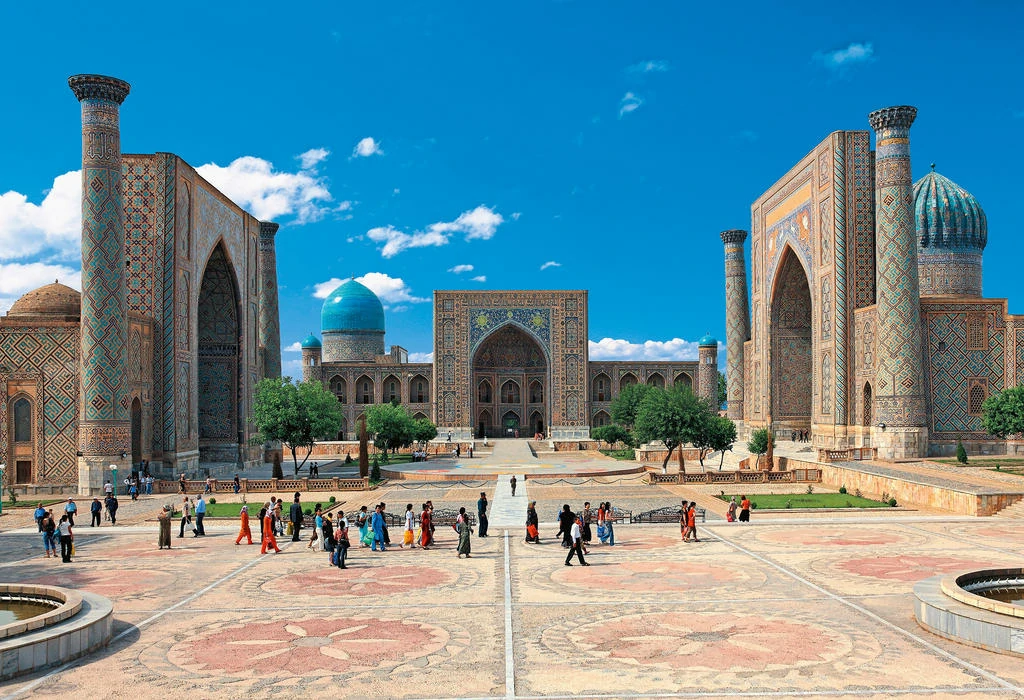
Exploring the Architectural Treasures of Samarkand
Featured on the
UNESCO World Heritage List and celebrated worldwide for its rich culture and art, Samarkand has inspired many of history’s greatest artistic minds. Take a tour through some of
the city’s most magnificent monuments.

The name Samarkand conjures an image of the old Silk Road, blue domes, brightly colored tile work and cosmopolitan charm, deep in Central Asia. It is a romantic image that can still be experienced on a visit today thanks to the preservation of a number of fine monuments.
The architectural gems of this city have stood the test of time, enduring wars and the aftermath of revolution while continuing to enchant visitors today, just as they must have centuries ago. Each holds a special place in the hearts of locals. ‘[These buildings] are a part of our national identity and help showcase the role we played in Central Asia’s culture,’ says local teacher Umid Porsaev. ‘They remind us of who our forefathers were, who we are, and what we aspire to be.

The Tomb of Amir Timur
To understand the historical importance of Samarkand, look at its most famous ruler: Amir Timur. Immortalized in the West as Tamerlane, Timur chose the city as the capital of his empire in the 14th century, giving it a wealth of attention and treasures. While his legacy in many countries is one of war, brutality and conquest, in Samarkand he is also remembered as a patron, the man credited with taking the country to its greatest heights.

It is
fitting, then, that one of the first major historic sites on the road into the
city from the train station is Timur’s tomb, the extravagant Gur-Emir, where he
is buried alongside many of his descendants. The tomb’s brilliant exterior and
blue domes look almost fantastical thanks to a riot of colours. Inside, the
tombs, niches and abundant calligraphy show the artisanal mastery of the era.
Through his many conquests, Timur brought riches, books and more to the city. “Samarkand was a real capital, and [Timur] ruled a massive empire that included many countries,” explains local tour expert Aygul Khanum. “He came from a humble background and rose to be very powerful; he was the one who made the city as great as it was.”

The madrasahs of Registan Square
Samarkand’s
influence would outlast the infamous Emir Timur, as successive rulers continued
to beautify the city. In Registan Square stand three massive madrasahs, the
Muslim name for both secular and religious educational buildings. Featuring the
stunning variety of blue tiles that are characteristic of this city, each has
turquoise, sea-green and cerulean niches, domes and minarets.
Tilya Kori Madrasah, Sher-Dor Madrasah and Ulugh Beg Madrasah were the universities of their time, places of learning that attracted students and thinkers from all over. The oldest in the square, Ulugh Beg Madrasah, was built in the 15th century by Mirza Ulugh Beg, the grandson of Emir Timur as well as an astronomer and scientist. The building’s ornate minarets rise like massive flutes, standing across the square from Sher-Dor Madrasah’s impressive iwan (vaulted hall), which is embellished with the image of two lions hunting deer as suns rise from their backs. “One interpretation of this symbol relates to the students,” says Khanum. “As you can see, the lion is pursuing the deer, serving as an inspiration for students to seek more knowledge.”

Mosques and tombs
The treasures of Samarkand have been recognized by UNESCO and continue to inspire travelers, bearing the imprint of a legacy of opulence that still thrives today. Historic mosques and tombs dot the city, and each has their own unique characteristics, from the massive Bibi-Khanym Mosque to the Rukhobad Mausoleum.

The Shah-i-Zinda Necropolis, a series of grand palatial tombs, has a combination of a haunting spirituality and an opulent aesthetic that sets it apart. The massive site, filled with rows of historic mausoleums, bursts with color and geometric patterns that epitomize Central Asian art and will linger in the memory. “For us, these buildings are unparalleled,” says Porseav. “They are like treasures that keep us local people proud.”


